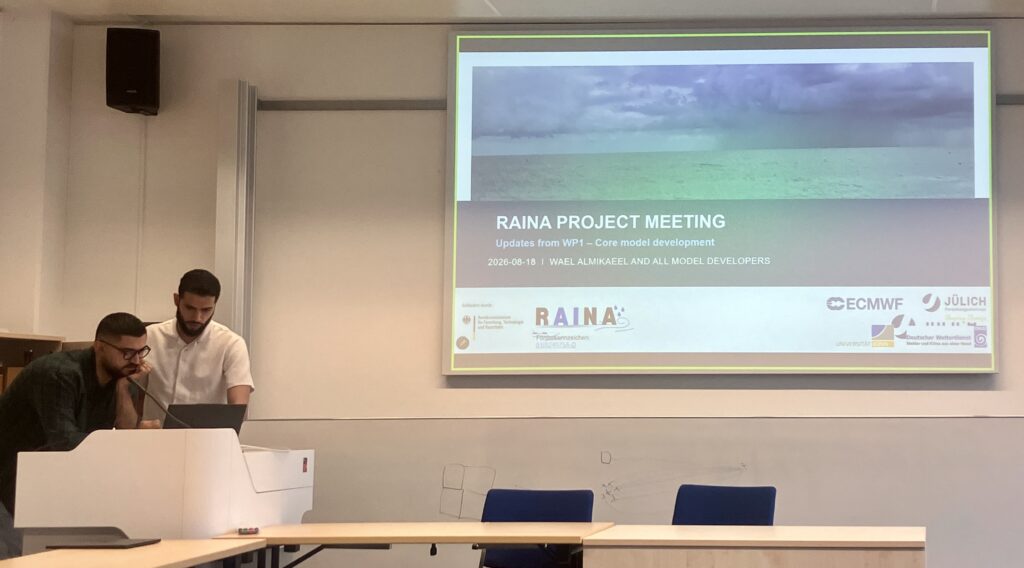
On 18 August 2026, the RAINA project partners gathered in person once again for a progress meeting, hosted for the second time by the University of Bonn. Bonn was chosen as the venue because it is easily accessible for all participating institutions: it is home to ECMWF, lies close to DWD’s headquarters in Offenbach near Frankfurt, and is just a short distance from Forschungszentrum Jülich (FZJ) to the west of the city.
Driven by strong motivation across all project partners and the promising results that have emerged from recent work, the meeting produced concrete plans to pursue publications on two fronts over the coming months.
The first concerns global precipitation forecasting, targeting a 6-hour forecast step with a rollout of up to five days. The second focuses on high-resolution probabilistic forecasting over Europe and Germany, designed to be probabilistic from the outset. This work will explore several approaches in parallel: running the WeatherGenerator and PrecMamba models directly at high resolution, as well as running both models at N320 resolution followed by a separate downscaling step. N320 refers to a reduced Gaussian grid commonly used in numerical weather prediction, with roughly 25 km horizontal resolution at the equator. Running the WeatherGenerator and PrecMamba models at N320 offers a computationally cheaper alternative to direct high-resolution forecasting, with a separate downscaling model then refining the output to the target resolution (e.g. ~1 km for RADKLIM).
For the high-resolution work, the partners plan to draw on a range of input datasets, including SEVIRI (~5 km), the ICON-DREAM Europe nest (~6.5 km), Synop observations, CERRA (~5.5 km), and RODEO. As target data for evaluation, the team will use RADKLIM precipitation (~1 km), ICON-FORCE wind components (~2 km), and Synop wind gusts.
The main probabilistic metrics discussed for evaluating this work include CRPS, weighted CRPS, rank histograms, marginal histograms, the Brier score for high thresholds, quantile scores, FSS, and PFSS.
Progress is being further accelerated by developments within the EU project WeatherGenerator, which both directly supports RAINA and provides a valuable point of comparison against PrecMamba, the model developed at the University of Bonn.
With these plans now in place, the main priorities for the coming months are, first, to align evaluation metrics and protocols across all partners as soon as possible, and second, to get the DWD MEC pipeline running with outputs from both WeatherGenerator and PrecMamba.